Notes on Musk's business loop
On 14 October I drew an architecture diagram in yBlocks of how Musk's companies fit together. It started from an analysis someone had put together. Its claim is that the companies are converging into one vertical chain, from power to chips to compute to a model to robots and distribution, with every link the customer of the one before it and the supplier of the one after. Mars sits at the end of the chain, mostly to carry the story.
yBlocks is my diagram lab. A diagram there is done when its structure is right, and I had not checked the analysis's dates and figures. Putting it here, where other people read it, meant checking each one against public material: mainly the S-1 that SpaceX filed with the SEC on 20 May[1], plus reporting from a handful of major outlets. The frame survived. Three claims were wrong, and several more needed qualifying.
What happened this year
On 2 February SpaceX's acquisition of xAI took effect, and xAI became a wholly owned subsidiary[1,2]. xAI had already acquired X on 28 March 2025, so this put rockets, satellites, a model and a social network inside one company. TechCrunch, citing Bloomberg, put the combined value at $1.25 trillion, the most valuable private company in the world at the time[2].
It stayed private for a little over four months. The analysis said SpaceX was heading for an IPO; it has already listed. The offering priced at $135 a share on 11 June and raised $75 billion, and the stock started trading on Nasdaq the next day as SPCX, closing its first day at $160.95, up 19%[3,4]. It is the largest IPO on record.
One figure in the S-1 says most about how the company presents itself. SpaceX puts its total addressable market at $28.5 trillion, of which $26.5 trillion, 93%, is AI[1,5]. A company built on rockets wrote its listing document mostly as an AI infrastructure company.
Tesla was not merged in, but it is tied in closely. In January Tesla agreed to put $2 billion into xAI preferred stock, payable once regulators signed off[6]. After the merger that subscription became SpaceX stock, and as of 1 May Tesla owned less than 1% of the company[1].
The tighter tie is Terafab. On 21 March Musk announced the chip-factory project in Austin, with Tesla, SpaceX and xAI behind it; Intel joined in April[1,7]. It is meant to make two kinds of chip first: inference chips for Tesla's cars and Optimus robots, and a chip called D3 for AI satellites in orbit. At the launch Musk said he wants 80% of its output to go to orbit and 20% to stay on the ground[7].
Drawing it
Pick a box to read why it is in the loop.
The three regions are the chain's three layers. On the left is the physical layer, where the analysis puts AI's real bottleneck: power, chips, compute and launch. Bottom right is the world, where the robots, the fleet, X and Starlink meet real people and real data. Top right, set apart, are the two outside suppliers the design means to replace. Which company owns a box is told by the mark on it.
Solid lines are things running today; dashed lines are plans. A packet walks the only artery that is built, from Tesla's storage into Colossus and from Colossus into Grok, and stops there.
Colossus is xAI's data centre in Memphis. Its first cluster was about 100,000 NVIDIA H100s, and Colossus II runs GB200 and GB300. Tesla's Megapacks there provide redundancy and smooth out peak demand; the main supply is the grid, and Colossus II is to run mostly on a dedicated natural-gas plant[1]. The analysis had the Megapacks powering Colossus, which stretches it. The S-1 does record the trade between the two: in 2025 xAI bought $506 million of goods and services from Tesla[1].
Every box can be opened, and says why it is on the chain, with the figures behind it. The diagram is small in the column; the button at its top right shows it full screen.
The arrow back carries money
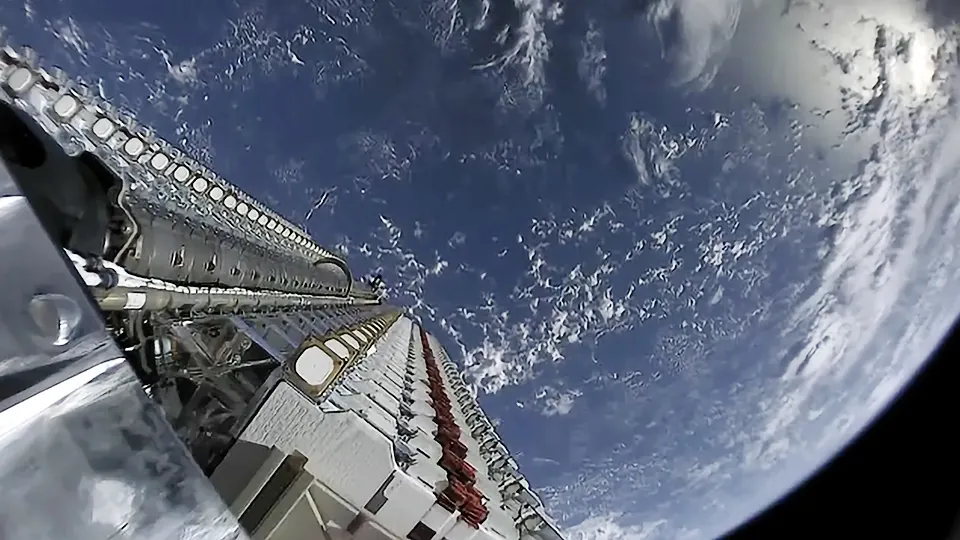
Only one solid line runs from the world back into the physical layer, from Starlink to Starship, and what it carries is money. The S-1 reports by segment: Connectivity, mostly Starlink, had $11.387 billion of revenue and $4.423 billion of operating income in 2025, in a year when the company as a whole lost $2.589 billion from operations[1]. CNBC put it more bluntly: Starlink is the only profitable unit[3].
The analysis says Starlink's profit is keeping Starship alive, which needs half a sentence more. In the first quarter of this year SpaceX spent about $10.1 billion on capital expenditure, $7.7 billion of it in the AI segment[1]. What Starlink pays for now is Starship plus an AI business that spends faster.
Three things it got wrong
The first is the orbital-compute timeline. The analysis had 1 GW of compute in orbit by the end of 2026 and 100 GW within three and a half years. What Musk said in an interview in early June was that by the end of next year, meaning the end of 2027, SpaceX should be deploying at a rate of 1 GW a year, and then work up to 10 and 100 GW a year, with the pace depending on chips and fabs[8]. The year is one later, and both 1 GW and 100 GW are amounts added per year.
The timeline does not agree with itself, either. The S-1 says deployment of orbital AI compute satellites begins as early as 2028[1]. In late August Musk posted on X that the first AI satellites launch in the fourth quarter of 2027 and reach significant scale in 2028, running on NVIDIA chips[9]. The diagram files NVIDIA under the suppliers to be replaced; in orbit, the first batch still runs on it.
The second is a quote. The analysis has Musk saying of Terafab that "this is not a commitment", and I could not find those words in any public report. Two things come close. The S-1 says SpaceX and Tesla have agreed only a general framework for Terafab, that timelines, milestones and capital spending for any project are subject to separate negotiation and have not been determined, and that neither Tesla nor Intel is obliged to stay in the project[1,10]. And in a video before the listing Musk said, "This is not a promise of what we'll do." He was talking about SpaceX's plans as a whole, not Terafab in particular[11].
The analysis's line that Terafab has no budget is out of date as well. A public hearing notice in Grimes County, Texas, on 6 May put the first phase at no less than $55 billion and the full build at up to $119 billion[12]. There are figures now; there is still no binding agreement.
The third is xAI's revenue, and the trouble is the scope. The analysis says xAI's annualised revenue was under $1 billion at the start of 2026, less than 5% of OpenAI's. Sherwood reported that xAI had $107 million of revenue in the third quarter of 2025 and a net loss of $1.46 billion in the same quarter[13]. OpenAI's chief financial officer said its annualised revenue passed $20 billion in 2025[14]. Counting xAI alone, that is about 2% of OpenAI, so the analysis holds. But the S-1's AI segment includes X, and had $3.201 billion of revenue in 2025[1], about a sixth of OpenAI on that basis. Both numbers are true; mixing them is where it goes wrong.
The diagram has a simplification of its own. The TSMC box in the top right stands for whoever fabricates Tesla's chips today, and the real picture is messier. Musk confirmed last November that both AI5 and AI6 are made at Samsung as well as TSMC[15], and Samsung's Texas fab began AI5 production in July[16]. Strictly, the outside suppliers need a Samsung box too. I kept the yBlocks structure and added that line to the TSMC box's note.
Where it stands
The analysis's verdict was that the story has closed and the cash flow has not. Having gone through the public material, I agree, and the numbers make it sharper. Starlink, with $4.4 billion a year of operating income, is carrying an AI segment that spends $7.7 billion in a single quarter. The only part of the diagram that turns on its own is the solid stretch.
Whether these companies end up as one, with Tesla folded in too, the analysis treats as a matter of time and a shareholder vote. I found nothing public that supports or rules that out, so the diagram leaves it undrawn. One sentence from the S-1's risk factors belongs here more than my guess does: "we have not, and no one else has, previously operated or attempted to operate orbital AI compute."[1]
Sources
- 1Form S-1 Registration Statement, Space Exploration Technologies Corp.SEC EDGAR · 2026-05-20
- 2Elon Musk's SpaceX officially acquires Elon Musk's xAI, with plan to build data centers in spaceTechCrunch · 2026-02-02
- 3SpaceX raises $75 billion in record-setting IPO ahead of Nasdaq debutCNBC · 2026-06-11
- 4SpaceX stock gains 19% in historic IPONBC News · 2026-06-12
- 5SpaceX IPO targets $28.5 trillion total addressable market, mission to 'make life multiplanetary'Fortune · 2026-05-20
- 6Tesla invests $2 billion in Elon Musk's xAI cash furnaceElectrek · 2026-01-28
- 7Elon Musk announces ambitious $20B Terafab project to manufacture chips for space-based AISiliconANGLE · 2026-03-22
- 8Musk: 'Magic' not needed for SpaceX's orbital AI data center planLight Reading · 2026-06-10
- 9Musk Sees SpaceX's Orbital Data Center Launch Near End of 2027Bloomberg · 2026-08-24
- 10SpaceX S-1 reveals Tesla's Terafab deal is far from doneElectrek · 2026-05-20
- 11SpaceX reveals plans for orbital data centers, Terafab ahead of historic IPOKBTX · 2026-06-10
- 12Elon Musk's SpaceX chip fab in Texas to cost up to $119 billionCNBC · 2026-05-06
- 13xAI's revenue is growing, but so are its staggering lossesSherwood News · 2026-01-09
- 14OpenAI CFO says annualized revenue crosses $20 billion in 2025Yahoo Finance · 2026-01-19
- 15Musk confirms Tesla AI5 and AI6 will be made at both Samsung and TSMC, reinforcing dual-foundry strategyYahoo Finance · 2025-11-11
- 16Samsung's Texas fab enters production for Tesla's AI5 chip on 2nmElectrek · 2026-07-13